

Workfare Income Supplement 2026 Singapore: Up to $4,900 a Year for Employees, Self-Employed and Platform Workers

Workfare Income Supplement (WIS) is the Singapore Government's wage top-up for lower-income workers. Introduced in 2007, it has paid out more than $12.9 billion to 1.13 million workers as of February 2026 (CPF Board figures).
In 2026 the maximum payout is $4,900/year for employees aged 60+ in the lowest income tier, $3,267/year for self-employed persons (SEPs), and $3,267/year for platform workers (Grab, Foodpanda, Deliveroo, etc). Crucially: employees and platform workers now receive WIS monthly, while SEPs still get it once a year after declaring income to IRAS.
Table of Contents
1. What Workfare is and who qualifies in 2026
2. Workfare for employees: up to $4,900/year (40% cash, 60% CPF)
3. Workfare for self-employed: up to $3,267/year (10% cash, 90% MediSave)
4. Workfare for platform workers: monthly payouts from 2025, equalised by 2029
5. Workfare 2026 payout schedule and PayNow vs GovCash
6. The income, AV and property catches that disqualify you
7. How Workfare stacks with GSTV, Majulah, Assurance Package and CDC Vouchers
1. What Workfare is and who qualifies in 2026
Workfare has three eligibility shells depending on what kind of worker you are. The shared baseline:
- Singapore Citizen - PRs do not qualify
- Aged 30 or older as of 31 December of the work year - or a person with disabilities (PWD) of any age
- Earning between $500 and $3,000/month gross (raised from $2,500 in Work Year 2024) - Workers earning below the usual $500 monthly income floor may still qualify for concessionary WIS if they fall into specific support groups.
- Annual Value (AV) of your home is $21,000 or below as at 31 December of preceding year - this is more restrictive than GSTV ($31,000)
- You own no more than 1 property - includes HDB, private and non-residential
- If married: you and your spouse together own no more than 1 property AND your spouse's assessable income is $70,000 or less for the preceding YA
Concessionary WIS (no income floor)
The $500/month income floor is waived for three groups - they qualify for $400/year flat-rate concessionary WIS even with zero income:
- Persons with disabilities (PWDs)
- Workers receiving ComCare Short-to-Medium-Term Assistance (STMA)
- Caregivers of care recipients - typically those residing with someone medically certified to have permanent moderate-to-severe disabilities
This is the same concessionary tier that exists in the Majulah Package Earn and Save Bonus - same three groups, same logic.
2. Workfare for employees: up to $4,900/year (40% cash, 60% CPF)
Employees receive the highest WIS rates, paid monthly, with 40% in cash and 60% in CPF contributions. The 2026 amounts (for Work Year 2025 work, paid in 2026) bumped up significantly from Work Year 2024:
Employee WIS: maximum annual payout by age
Age band | Work Year 2024 (paid in 2025) | Work Year 2025 (paid in 2026) |
30-34 | $2,100 | $2,450 |
35-44 | $3,000 | $3,500 |
45-59 | $3,600 | $4,200 |
60 and above (or PWD) | $4,200 | $4,900 |
Two important nuances:
- These are MAXIMUM amounts - actual payout depends on your income and how many months you work. A 60-year-old who earns $1,000/month for 6 months won't hit $4,900
- Cash split: 40% lands in your bank account (PayNow-NRIC if linked, otherwise the bank you registered with CPF, or GovCash). The other 60% goes into your CPF Ordinary, Special and MediSave accounts in standard allocation ratios
No action needed if you're a CPF-contributing employee
Your eligibility is automatically assessed every month based on the CPF contributions your employer makes. If your employer is not contributing CPF on your behalf, two steps:
- Approach your employer first to clarify the discrepancy.
- If they don't respond satisfactorily, lodge a report with CPF Board via the official enquiry form on cpf.gov.sg or call the CPF hotline at 1800 227 1188.
CPF Board takes employer non-contribution seriously - CPF will pursue back-contributions on your behalf, retroactively triggering any WIS you missed.
3. Workfare for self-employed: up to $3,267/year (10% cash, 90% MediSave)
Self-employed persons (SEPs) - hawkers, freelancers, sole proprietors, taxi drivers operating their own vehicle - receive Workfare on a different schedule and split. Annual lump sum, not monthly. 10% in cash, 90% in MediSave.
Self-Employed WIS: maximum annual payout by age
Age band | Work Year 2024 (paid 2025) | Work Year 2025 (paid 2026) |
30-34 | $1,400 | $1,633 |
35-44 | $2,000 | $2,333 |
45-59 | $2,400 | $2,800 |
60 and above (or PWD) | $2,800 | $3,267 |
'%20fill='url(%23a)'%20fill-rule='evenodd'%20opacity='.04'/%3e%3c/svg%3e)
Why SEP rates are lower: the policy logic is that SEPs already get the cash equivalent of employer CPF contributions through their own pricing. WIS for SEPs is calibrated to match what an employee would receive after netting out the "employer share" CPF contribution.
Two things SEPs must do (or no WIS)
Unlike employees, SEPs need to actively complete two steps before payout:
- Declare your Net Trade Income (NTI) to IRAS by filing a tax return. Filing window: 1 March to 18 April of the following Work Year. If your NTI is below $6,000 and total income below $22,000 (no IRAS notification received), you can still e-File via myTax Portal until 31 October.
- Pay your full MediSave contribution based on your declared NTI. The amount is calculated by CPF Board from your IRAS-assessed NTI - check your liability via the WIS e-services on cpf.gov.sg.
Key timing: if both steps are done by 31 March, you get WIS by end April of the following Work Year (e.g. complete by 31 March 2026 → WIS by end April 2026). Miss the deadline and you'll get WIS within 2 months of completing your MediSave contribution - so paying late directly delays your payout.
What if your NTI is below $6,000?
You're not required to pay MediSave under the Self-Employed Scheme (SES). BUT to qualify for WIS you must voluntarily make the MediSave contribution within 2 years of the work year. Many low-income SEPs miss WIS purely because they didn't realise this voluntary contribution was the trigger.
4. Workfare for platform workers: monthly payouts from 2025, equalised by 2029
Platform workers - Grab, Foodpanda, Deliveroo, Lalamove, Gojek drivers and riders - had a major regime change from 2025. Here's what changed and what it means in 2026:
From 2025: monthly WIS via platform CPF deductions
Previously, platform workers were treated as SEPs and waited until the following year for a single annual payout. From 2025, eligible platform workers receive WIS monthly because platform operators (Grab, Foodpanda, etc) now deduct CPF contributions and submit them to CPF Board every month - same mechanism as employees.
Schedule and split (2025 to 2028):
- Maximum amounts: same as SEPs ($1,633 to $3,267 by age) for now
- Cash split: 10% cash, 90% MediSave - still on SEP-style allocation
- Frequency: monthly, end of month (x+2) for work done in month x
From 2029: equalised with employees IF you opt in
From 2029, platform workers who are mandated or opt in to the increased CPF contributions will receive WIS at the SAME level as employees - up to $4,900/year for the 60+ age band. This is a significant uplift (from $3,267 → $4,900 = +$1,633/year).
Workers who don't opt in stay on the SEP rate. The opt-in trade-off: higher CPF deductions from your gross now, in exchange for higher CPF/MediSave balances and higher WIS later. For older platform workers close to retirement, opting in usually pencils out.
What if your platform isn't deducting CPF?
Same recourse as employees: clarify with the platform operator first, then lodge a report with CPF Board if no response. Platform CPF compliance is a new area being actively enforced - CPF Board has the same back-contribution powers it has for traditional employers.
5. Workfare 2026 payout schedule and PayNow vs GovCash
Workfare follows a predictable monthly schedule for employees and platform workers, with PayNow-NRIC delivering payments roughly 2 weeks faster than GovCash:
Monthly Workfare schedule (employees and platform workers)
Work done in | PayNow-NRIC / Bank crediting | GovCash (no PayNow linked) |
January | End March | 1st week of April |
February | End April | 1st week of May |
March | End May | 1st week of June |
Month X | End of month (X+2) | 1st week of month (X+3) |


SEPs are different - one annual payout. The earliest possible date is end April of the following Work Year (e.g. WY2025 → end April 2026), and only if NTI declared and MediSave paid by 31 March.
Why PayNow-NRIC matters more for Workfare than for GSTV
GSTV pays once a year so the GovCash delay is a one-time inconvenience. Workfare pays MONTHLY, so the GovCash delay compounds - 12 weeks of slower cashflow over a year. For a 60-year-old hitting the $4,900 max ($1,960/year cash portion), that's about $163/month landing 1-2 weeks late if you're on GovCash.
Linking PayNow-NRIC at any participating bank takes about 2 minutes via your bank's mobile app - look for "PayNow setup" and select NRIC linking. Full instructions on the official PayNow page.
6. The income, AV and property catches that disqualify you
A surprising number of workers ASSUME they qualify but get disqualified by silent criteria. The most common traps:
The AV $21,000 trap
Workfare's AV ceiling ($21,000) is significantly tighter than GSTV's ($31,000) and Majulah's ($31,000). A $21k AV typically corresponds to:
- HDB flats: virtually all qualify - even executive HDB flats are likely under $21k AV
- Private condos: smaller and older units may scrape under, but newer or larger condos exceed it
- Landed: almost always exceeds $21k AV
Check your home's AV at mytax.iras.gov.sg - log in with Singpass and look up your property. The AV updates after every reassessment, so a property near $21k could push you out one year and back in the next.
The spouse income trap
If you're married, your spouse's assessable income for the preceding YA must be $70,000 or less. This catches dual-income households where one partner is the lower earner targeted by WIS but the other earns above $70k - the higher earner's income disqualifies the lower-earning spouse from WIS entirely.
The 12-month average income trap
Even if you earn $2,800/month right now, your average gross monthly income over the past 12 months must also be at or below $3,000. Workers who got a recent pay raise or returned from a high-paying gig can find themselves disqualified despite being currently within the cap.
The "more than 1 property" trap
Owning 2+ properties (including non-residential like a small commercial unit) disqualifies you outright, regardless of income. The AV check applies to your primary residence; the property count is separate.
The unemployment trap
Workfare requires you to actually work in the assessment month. If you're unemployed, you don't qualify for that month - even if you would have been eligible by all other criteria. WIS resumes the moment you start working again (and CPF contributions get made on your behalf).
7. How Workfare stacks with GSTV, Majulah, Assurance Package and CDC Vouchers
The Workfare cohort (lower-income working SCs aged 30+) almost always overlaps with GSTV, sometimes with Majulah (if 53+ and born before 1973), and always with CDC Vouchers. Here's the typical stack:
Workfare vs other government schemes 2026
Scheme | Who qualifies | What you get |
Workfare (WIS) | SC 30+, income $500-$3k/mo, AV ≤ $21k, ≤1 property | Up to $4,900/year (employee), $3,267 (SEP/platform) |
GST Voucher | SC 21+, AI ≤ $39k, AV ≤ $31k | Up to $850 Cash + $450 MediSave + U-Save annually |
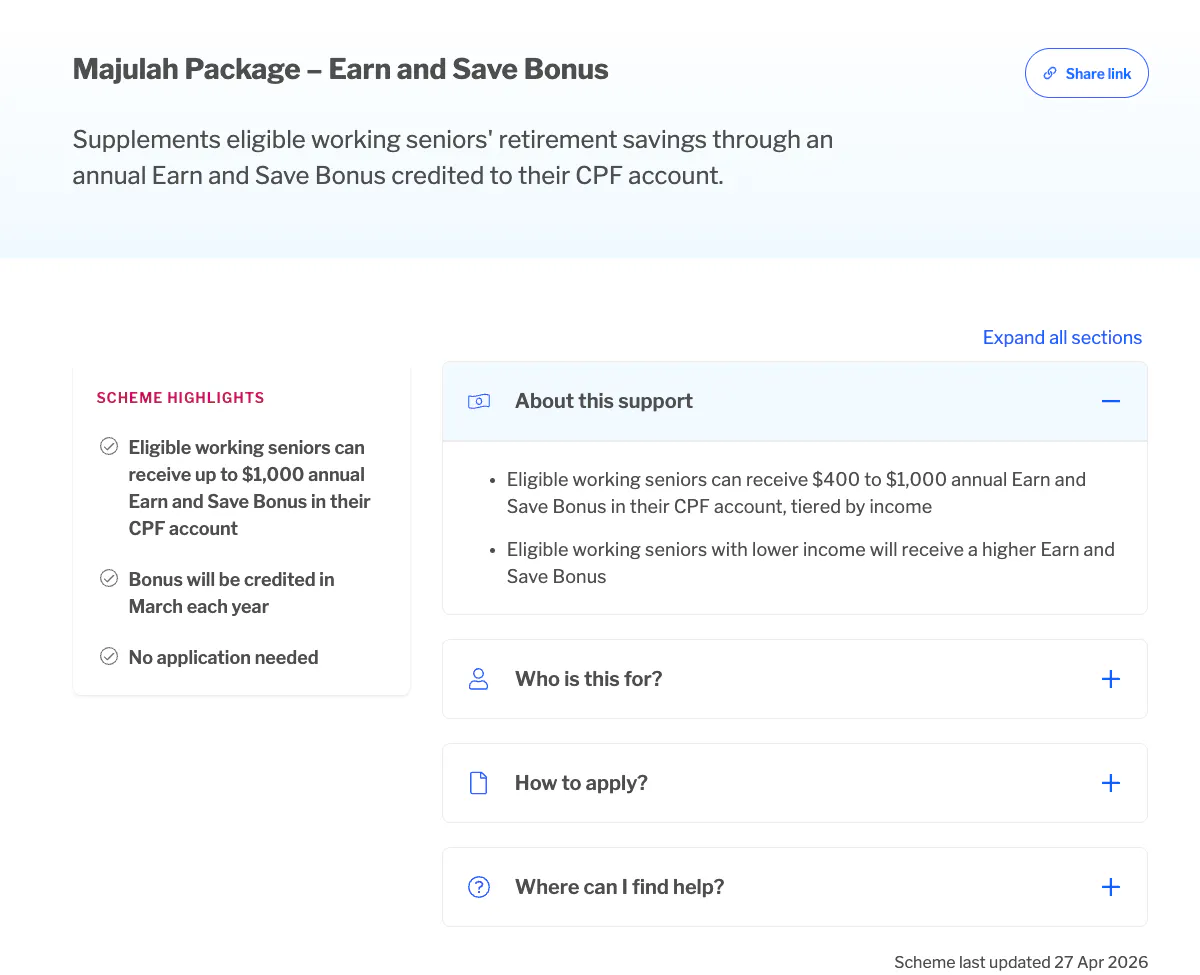
Majulah Package | SC born 1973 or earlier, working, AV ≤ $31k | ESB up to $1,000/year to CPF + one-time RSB/MediSave (already paid) |
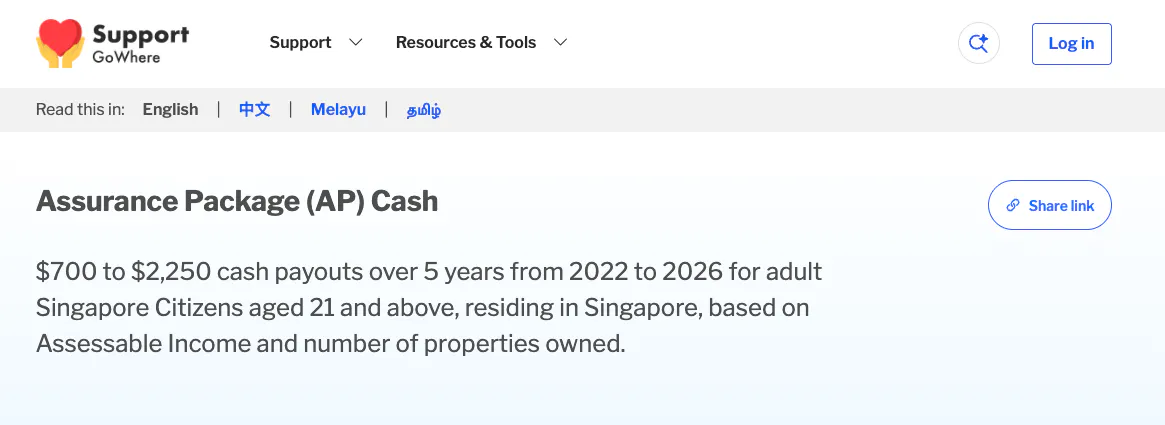
Assurance Package | All SC adults | Final $250 Cash tranche Dec 2026, then ENDS |
CDC Vouchers | All SC households | $300/household/year (split hawker + supermarket) |
Stacking math for a typical Young Senior employee (born 1965, age 61, $2,000/month income, HDB 4-room, single property):
- Workfare: $4,900/year ($1,960 cash to bank monthly + $2,940 to CPF) - new in 2026
- Majulah ESB: $1,000/year to CPF (paid March 2026) - see our Majulah guide
- GSTV 2026: ~$850 Cash + $450 MediSave + U-Save in August - see our GSTV guide
- Assurance Package: final $250 Cash tranche in December - see our AP guide
- CDC Vouchers: $300/year - see our CDC guide
Annual total: roughly $3,360 in cash to spend, plus $4,840 to CPF/MediSave for retirement and healthcare. That's before SG60 vouchers, Climate Voucher and any U-Save rebates.
8. Action checklist: claim, calculate, contest
If you're an employee
- Verify CPF contributions are being made: log into cpf.gov.sg with Singpass and check your contribution statement.
- Link PayNow-NRIC at your bank if not already done - 2 minutes via mobile app.
- Use the WIS calculator on cpf.gov.sg to estimate your annual payout based on your income and age.
- Check WIS payments on the WIS e-services - shows your eligibility, payments and any actions needed.
- If your employer isn't contributing CPF: clarify with them, then report to CPF Board if unresolved.
If you're self-employed
- File your Year of Assessment 2025 income tax return with IRAS by 18 April 2026 (or e-File via myTax Portal by 31 October 2026 if not required to file).
- Pay your MediSave contribution in full based on your assessed NTI - the amount is shown in your WIS e-services dashboard.
- If your NTI is below $6,000: you're not required to pay MediSave under SES, but you MUST pay it voluntarily within 2 years to qualify for WIS. Don't skip this.
- Aim to complete declaration + MediSave payment by 31 March - this is the cut-off for receiving WIS by end April of the same year.
If you're a platform worker
- Confirm your platform operator is deducting and submitting CPF contributions on your behalf each month - check via cpf.gov.sg.
- Decide on opt-in to increased CPF contributions before 2029 - this unlocks the higher employee-equivalent WIS rate.
- Same monthly payout schedule applies - link PayNow-NRIC for fastest receipt.
If you think you should qualify but didn't get paid
- Check your AV at mytax.iras.gov.sg - the $21k cap is the most common silent disqualifier.
- Check your spouse's assessable income (if married) - the $70k spouse cap is the second most common.
- Check your 12-month average income, not just current month - a recent pay raise can push you over.
- Contact CPF Board: WIS hotline 1800 227 1188 (Mon-Fri 8am-5.30pm), or file an enquiry via cpf.gov.sg.
Related government payouts you might qualify for
Two more income-tested government cash schemes that stack with Workfare - the same lower-income worker profile often triggers all three.
GST Voucher 2026: up to $850 cash + $450 MediSave top-up + double U-Save rebates for lower-income Singapore Citizens (assessable income $39,000 or less).
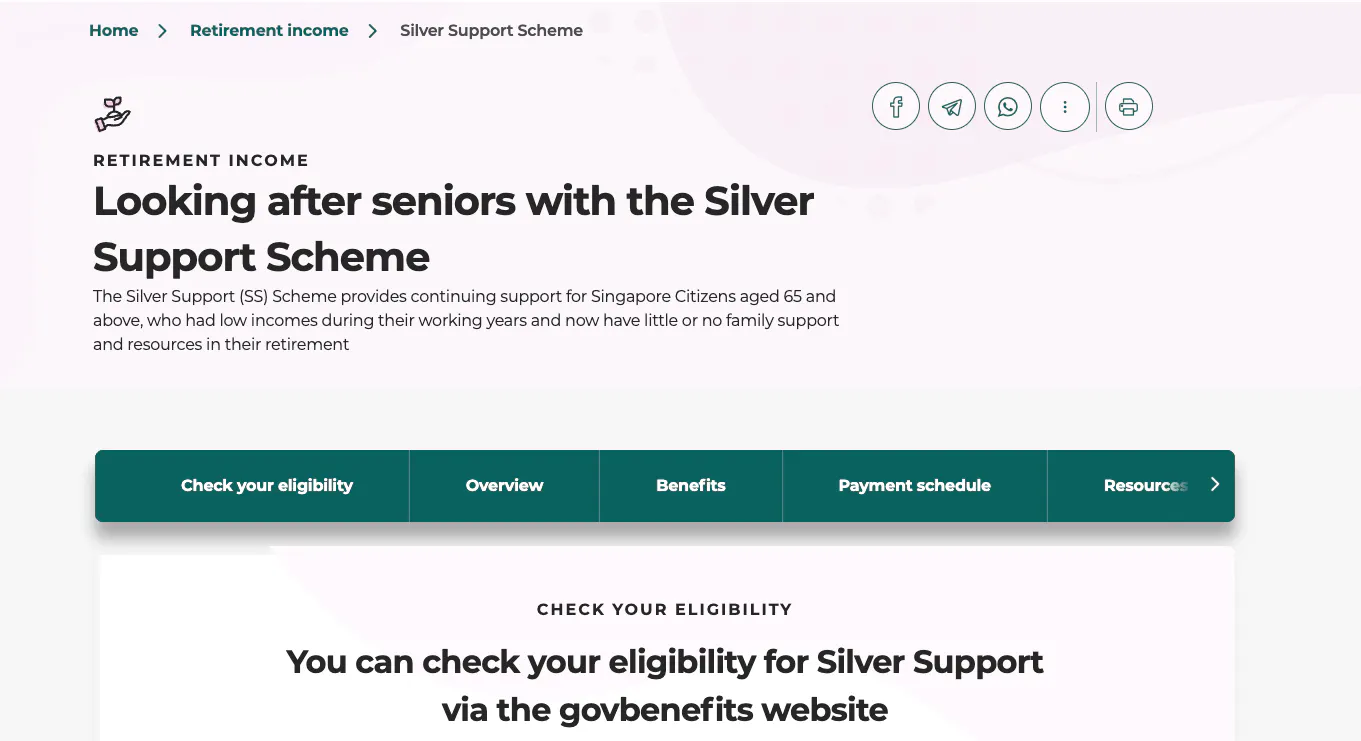
Silver Support Scheme 2026: up to $4,320 a year for SC seniors aged 65+ with low lifetime CPF contributions, living in a 1- to 5-room HDB flat.