


The New Parent Money Stack: Every Dollar Singapore Gives You for Having a Baby


Most new parents in Singapore know they'll get "some Baby Bonus money." But when you actually add up every government payout, grant, tax relief, and credit available to a new parent - the total is far larger than most people realise.
For a first child born in 2025 or later, the combined value is over $31,000 in direct grants, credits, and tax rebates - and over $49,000 for a third child. Much of it is automatic or requires just a few clicks on the LifeSG app.
The problem is that this information is scattered across life.gov.sg, cpf.gov.sg, iras.gov.sg, profamilyleave.msf.gov.sg, and several other portals. This guide consolidates everything into one place: every dollar, when it arrives, and what you need to do to claim it.
All amounts sourced from official government websites. Applies to Singapore Citizen children born on or after 18 February 2025.
Important update: Baby Bonus is being replaced. The SG Child Support Package announced at the 2026 National Day Rally will replace the Baby Bonus and Large Families Schemes, with payouts starting from April 2027. Children enrolled in Baby Bonus will be transitioned automatically, so the amounts below are what you can still claim in the meantime.
Table of Contents
- The total picture: how much you actually get
- Baby Bonus Cash Gift - the payment schedule
- CDA First Step Grant + Co-Matching - the free money most parents don't maximise
- Child LifeSG Credits - $500 per child (budget-dependent)
- MediSave Grant for Newborns
- Government-paid parental leave - what changed in 2025
- Tax reliefs for parents
- The 3 mistakes new parents make
- The action checklist
1. The total picture: how much you actually get
Here's the full stack for a Singapore Citizen child born on or after 18 February 2025. All amounts are confirmed from official government sources.
Total Government Support by Birth Order
Component | 1st Child | 2nd Child |
Baby Bonus Cash Gift | $11,000 | $11,000 |
CDA First Step Grant | $5,000 | $5,000 |
CDA Co-Matching (max) | $4,000 | $7,000 |
MediSave Grant for Newborns | $5,000 | $5,000 |
Child LifeSG Credits ($500 x 2 tranches, 2025 and 2026) | $1,000 | $1,000 |
Subtotal: cash, grants and credits | $26,000 | $29,000 |
Parenthood Tax Rebate (offsets tax payable, not cash) | $5,000 | $10,000 |
Total including the tax rebate | $31,000 | $39,000 |
Read that total carefully. The Parenthood Tax Rebate is a rebate against tax payable, not a payment, so you only benefit from it if you owe income tax. The CDA co-matching figure is a cap, not a gift: the Government matches what you actually save, dollar for dollar, up to that amount.
The MediSave Grant for Newborns goes into your child's MediSave account for healthcare use rather than arriving as spendable cash. So the amount that reaches your bank account is smaller than the headline total.
For a third child born on or after 18 February 2025, the numbers jump significantly.
- Baby Bonus Cash Gift - $13,000
- CDA First Step Grant - $10,000 (doubled under the Large Families Scheme)
- CDA Co-Matching cap - $9,000
- MediSave Grant for Newborn - $5,000
- Large Family MediSave Grant - $5,000 (deposited into the mother's MediSave)
- Large Family LifeSG Credits - $6,000 total ($1,000/year from age 1 to 6)
- Child LifeSG Credits - $1,000 (confirmed for 2025 and 2026)
- Parenthood Tax Rebate - $20,000
Total for a third child: approximately $69,000, which again includes the $20,000 Parenthood Tax Rebate rather than being all cash.
On top of that, working mothers can claim $12,000 in Working Mother's Child Relief (tax relief for a 3rd child), both parents get $4,000 in Qualifying Child Relief, and the government pays for 16 weeks of maternity leave plus 4 weeks of paternity leave. The real total is higher still.
2. Baby Bonus Cash Gift - the payment schedule
The Baby Bonus Cash Gift is deposited into your child's Child Savings Account (CSA) - a joint savings account opened alongside the CDA. Unlike the CDA, the CSA has no restrictions on how you use the money. It's real cash you can withdraw.
Cash Gift Payment Schedule (1st/2nd Child)
When | Amount | Cumulative |
At birth | $3,000 | $3,000 |
6 months | $1,500 | $4,500 |
12 months | $1,500 | $6,000 |
18 months | $1,000 | $7,000 |
2 years to 6.5 years | $400 every 6 months | $11,000 total |
For a 3rd or subsequent child, the amounts increase:
- $4,000 at birth
- $2,000 at 6 months
- $2,000 at 12 months
- $1,000 at 18 months
- $400 every 6 months until age 6.5,
totalling $13,000.
The first payment arrives within 7-10 working days of opening your bank accounts. You'll receive an SMS or email notification 3-5 working days before each subsequent payment.
'%20fill='url(%23a)'%20fill-rule='evenodd'%20opacity='.04'/%3e%3c/svg%3e)
3. CDA First Step Grant + Co-Matching - the free money most parents don't maximise
First, what is a CDA? The Child Development Account is a special government co-savings account for your child. It can only be used to pay for approved child-related expenses like childcare, kindergarten, and medical bills at approved institutions. You cannot withdraw CDA funds as cash. Think of it as a ring-fenced education and healthcare fund that the government helps you fill.
The CDA is where the real hidden value is, because it has two components - and most parents only know about one of them.
First Step Grant - free, no saving needed
Once your child is enrolled in the Baby Bonus Scheme and you select your bank, the CDA is automatically opened within 3 to 5 working days. The government then deposits the First Step Grant of $5,000 (or $10,000 for 3rd+ child under the Large Families Scheme) within 2 weeks. You don't need to save anything first, and you can use it immediately at approved institutions - childcare centres, kindergartens, clinics, and hospitals.
Government co-matching - save $1, get $1 free
On top of the First Step Grant, the government matches every dollar you deposit into the CDA, dollar-for-dollar, up to a cap. The co-matching is credited within 2 weeks of your deposit.
CDA Co-Matching Caps
Birth Order | Co-Matching Cap |
1st child | $4,000 |
2nd child | $7,000 |
3rd / 4th child | $9,000 |
5th+ child | $15,000 |
Example: for your first child, if you deposit $4,000 into the CDA over time, the government adds another $4,000. Combined with the $5,000 First Step Grant, your child's CDA will hold $13,000 - of which $9,000 came from the government.
The mistake most parents make: they don't deposit enough (or anything) into the CDA to trigger the full co-matching. That's leaving free money on the table. You have until 31 December of the year your child turns 12 to maximise the matching - so there's no rush, but don't forget entirely.
CDA funds can be used at approved institutions including childcare centres, kindergartens, and medical institutions. When your child turns 12, any remaining balance transfers to their Post-Secondary Education Account (PSEA) for future education expenses.
4. Child LifeSG Credits - $500 per child (budget-dependent)
Starting from Budget 2025, the government has disbursed $500 in Child LifeSG Credits for every Singapore Citizen child aged 0-12. Budget 2026 announced the same $500 again. However, this is currently a budget-dependent measure - it is not a guaranteed permanent annual scheme like the Baby Bonus.
- 2025 Credits - $500 per eligible SC child aged 0-12 in 2025. Disbursed to the CDA trustee via the LifeSG app.
- 2026 Credits - $500 per eligible SC child aged 0-12 in 2026. Disbursed around July 2026 (for 2014-2025 born children) and April 2027 (for 2026-born children).
- Usable at - any merchant that accepts PayNow UEN QR or NETS QR. Much broader than CDA - supermarkets, hawker centres, retail shops, etc.
Important: for a first child born in 2025, the confirmed total from this scheme so far is $1,000 ($500 for 2025 + $500 for 2026). Future years depend on future Budget announcements. We have not included speculative future credits in our total calculation above.
For third and subsequent children, there is a separate guaranteed scheme: the Large Family LifeSG Credits provide $1,000 per year from the year the child turns 1 to the year the child turns 6 - totalling $6,000. This is on top of the budget-dependent Child LifeSG Credits.
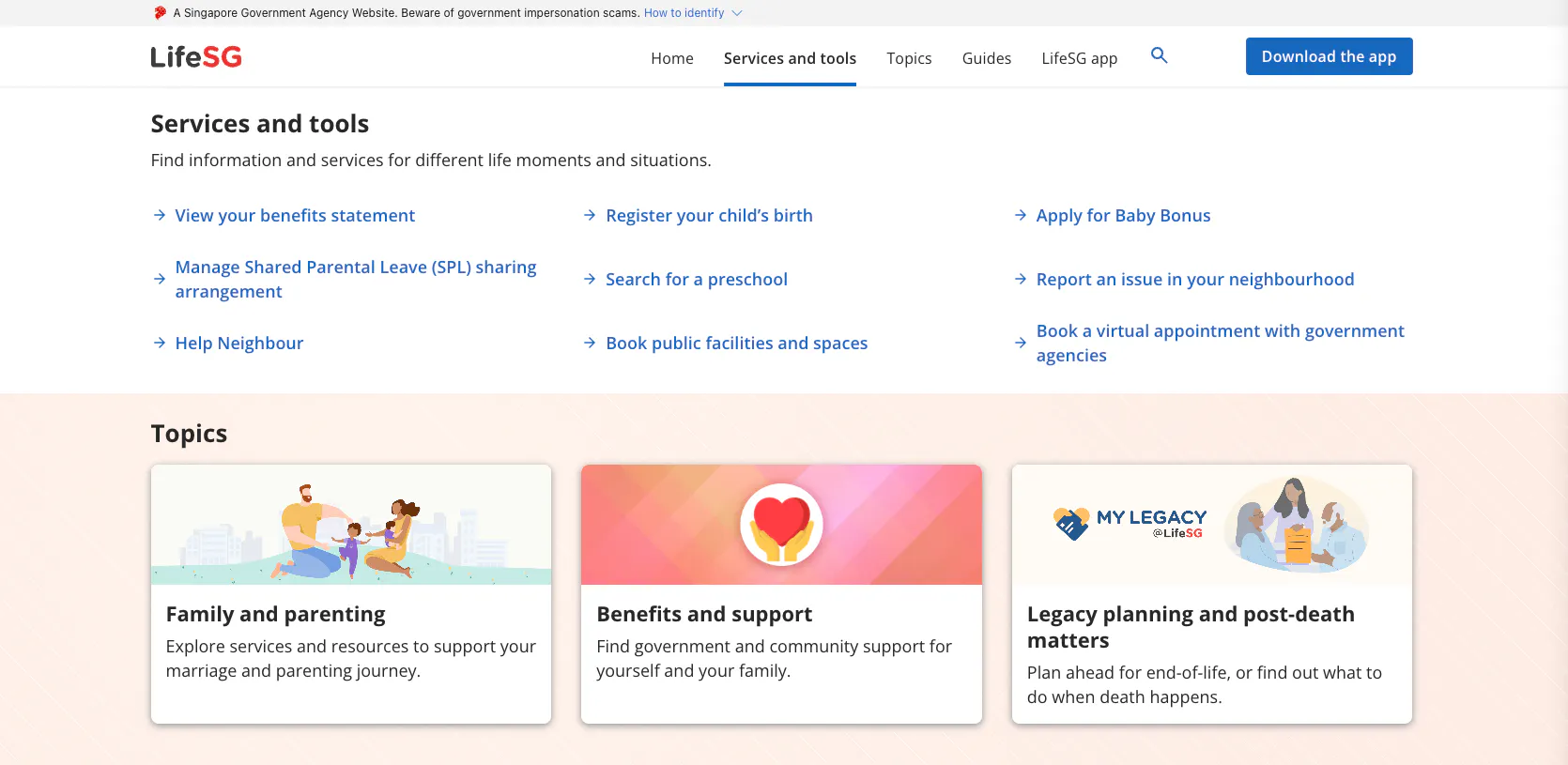
Action needed: make sure you have the LifeSG app installed and your child’s CDA trustee details are up to date.


5. MediSave Grant for Newborns - $5,000 automatically deposited
Every Singapore Citizen newborn receives a $5,000 MediSave Grant, deposited automatically into the child’s MediSave account. No application needed - it happens when your child is enrolled in the Baby Bonus Scheme.
This $5,000 helps cover your child’s healthcare costs, including MediShield Life premiums, vaccinations, and medical expenses at approved institutions.
Large Family MediSave Grant (3rd+ children)
For a third or subsequent child born on or after 18 February 2025, the mother also receives a one-time $5,000 Large Family MediSave Grant deposited into her own CPF MediSave account. This is separate from the $5,000 newborn grant - meaning the family receives $10,000 in total MediSave support for a third child.
6. Government-paid parental leave - what changed in 2025
Singapore enhanced its parental leave schemes from 1 April 2025. The biggest change: paternity leave doubled from 2 weeks to 4 weeks. Here's the full picture.
Government-Paid Leave for Parents (from 1 April 2025)
Leave Type | Duration | Paid By |
Maternity Leave | 16 weeks | 8 wks employer + 8 wks government (capped) |
Paternity Leave | 4 weeks (doubled from 2) | Government-paid (from 1 Apr 2025) |
Shared Parental Leave | 6 weeks (10 weeks from 1 Apr 2026) | Government-paid |
Childcare Leave | 6 days/year per parent (child < 7) | 3 days employer + 3 days government |
Extended Childcare Leave | 2 days/year per parent (child 7-12) | Employer-paid |
Unpaid Infant Care Leave | 12 days per relevant period (child < 2) | Unpaid |
The monetary value of 4 weeks of paternity leave is significant. If your monthly salary is $5,000, that's $5,000 in government-paid leave. Combined with 8 weeks of government-paid maternity leave (capped at $10,000/month), the leave benefits alone can be worth $15,000-25,000 depending on salary.
Self-employed parents are also eligible for Maternity Benefit, Paternity Benefit, and Shared Parental Leave Benefit - the government pays these directly even without an employer.
7. Tax reliefs for parents
Tax reliefs don't put cash in your hand directly, but they reduce your tax bill. For working parents, these add up to thousands of dollars in tax savings every year.
Tax Reliefs and Rebates for Parents
Relief | Amount | Who Can Claim |
Qualifying Child Relief (QCR) | $4,000 per child | Either parent |
Working Mother’s Child Relief (WMCR) | $8,000 (1st) / $10,000 (2nd) / $12,000 (3rd+) | Working mothers only (children born/adopted from 1 Jan 2024) |
Parenthood Tax Rebate (PTR) | $5,000 (1st) / $10,000 (2nd) / $20,000 (3rd+) | Either parent (can be carried forward) |
Grandparent Caregiver Relief | $3,000 | Working mothers (parent/in-law cares for child) |
Important: the WMCR changed from a percentage of income to fixed dollar amounts for children born or adopted from 1 January 2024. This is a significant change - previously, high-income mothers got a larger relief. Now everyone gets the same flat amount per child order.
The Parenthood Tax Rebate (PTR) is different from a relief - it’s a direct dollar-for-dollar reduction of your tax payable. The $5,000 PTR for a first child can be shared between parents and carried forward to future years if you don’t use it all in one year.
Note: the Foreign Domestic Worker Levy Relief has lapsed from YA 2025 onward and is no longer available for new claims.
8. The 3 mistakes new parents make
Mistake 1: Not completing the Baby Bonus enrolment quickly
The First Step Grant and your first Baby Bonus Cash Gift only arrive after your child is enrolled in the Baby Bonus Scheme and the CDA/CSA accounts are opened with your chosen bank (POSB/DBS, OCBC, or UOB). The good news: once you register your baby's birth and apply for Baby Bonus via the LifeSG app, the bank accounts are created automatically within 3 to 5 working days. But some parents delay the birth registration itself, or don't complete the Baby Bonus application. Do it in the first few days and the money starts flowing within 1-2 weeks.
Mistake 2: Not depositing into the CDA to trigger co-matching
The co-matching is free money - but only if you deposit. For a first child, the cap is $4,000. That means if you save $4,000 into the CDA over your child's first 12 years, the government adds $4,000. That's a 100% guaranteed return. You don't need to deposit it all at once - even $50/month adds up. But if you deposit nothing, you get nothing.
Mistake 3: Forgetting to claim Child LifeSG Credits annually
Unlike the Baby Bonus which is automatic, the Child LifeSG Credits require you to have the LifeSG app set up. If you're not on the app, you may not realise the credits are waiting for you. Download LifeSG, log in with Singpass, and make sure your child's CDA trustee details are correct.
9. The action checklist: step by step
Here's the exact sequence of actions, from birth to beyond:
- Register your child's birth on the LifeSG app - the Baby Bonus application is part of this process.
- Choose your bank (POSB/DBS, OCBC, or UOB) during the Baby Bonus application - UOB doesn't require an existing account. The CDA and CSA will be automatically opened within 3-5 working days.
- Check that your CDA and CSA are active - your bank will notify you once the accounts are ready and linked to your internet banking. Verify the First Step Grant has landed.
- Start depositing into the CDA - even small amounts trigger the dollar-for-dollar co-matching. Set up a $100/month standing order and forget about it.
- Download the LifeSG app - this is where your Child LifeSG Credits will be disbursed. Make sure you're logged in as the CDA trustee.
- Claim parental leave via the GPL Portal - log in at profamilyleave.msf.gov.sg with Singpass. Fathers: you now have 4 weeks of government-paid leave.
- File for tax reliefs in your next tax return - claim QCR ($4,000), WMCR (if working mother), and PTR ($5,000 for first child) via myTax Portal.
- Set a calendar reminder for Child LifeSG Credits - they're disbursed around July each year. Check the LifeSG app annually.
Having a baby in Singapore is expensive - but the government support is genuinely substantial if you know where to look and what to claim. The key is acting quickly (open that CDA in the first week), saving consistently (even $50/month into the CDA), and not forgetting the annual credits and tax reliefs.
For more guides on maximising government support, check out our SkillsFuture Credit guide (up to $4,500 in free course credits) and our guide to free things in Singapore.
After Baby Bonus and CDA, the next recurring cost to plan is preschool. Our childcare subsidy guide explains ECDA infant care subsidy, childcare fees and the 2027 income-ceiling change.
Baby Bonus is being replaced. The SG Child Support Package pays up to $62,000 per child from birth to age 17, regardless of birth order.









![Top Family Friendly Holiday Destinations from Singapore [2026]](https://images.prismic.io/dive/aTvjJ3NYClf9oGZZ_Divedeals-1-.png?auto=format,compress)