

CPF Cash Top-Up Tax Relief 2026 Singapore: Up to $16,000 Off Your Tax Bill (Self, Spouse, Parents and More)


A CPF cash top-up is the most popular way Singaporeans cut their income tax bill at year-end. Top up your own CPF and you can knock up to $8,000 off your taxable income. Top up a parent's, spouse's or sibling's CPF on top of that and you get another $8,000, for a maximum $16,000 in tax relief per calendar year. Get the timing wrong and you forfeit the whole thing for the year.
Caps and rules in this guide are sourced from CPF Board (cpf.gov.sg) and IRAS. Last verified: 6 May 2026.
CPF cash top-up tax relief 2026 at a glance
Maximum tax relief | $16,000 per calendar year ($8,000 self + $8,000 loved ones) |
Deadline | 31 December - top-up must be received by CPF Board this calendar year |
Where the cash goes | Special Account (under 55), Retirement Account (55+), or MediSave |
Eligible recipients | Self, parents, parents-in-law, grandparents, grandparents-in-law, spouse, siblings (income conditions apply for spouse and siblings) |
Bonus: matching grant | Matched Retirement Savings Scheme (MRSS) - up to $2,000/year matched by Government for eligible parents aged 55-70 |
Table of Contents
1. Fast eligibility check: who can give and who can receive
2. How much CPF cash top-up tax relief you actually get in 2026
3. Where the cash top-up goes: OA, SA, RA or MediSave
4. Topping up your spouse, parents, siblings or grandparents
5. How to top up CPF online: PayNow QR, e-Cashier and the CPF app
6. Voluntary contribution vs RSTU vs MediSave Top-Up: which one are you doing
7. Matched Retirement Savings Scheme (MRSS) for parents aged 55 to 70
8. How CPF top-up stacks with SRS, Workfare, Silver Support and Majulah
1. Fast eligibility check: who can give and who can receive
You qualify for CPF cash top-up tax relief if YOU pay Singapore income tax. The recipient does not need to qualify for anything - tax relief always sits with the giver, not the receiver. The table below covers who can give, who can receive, and the most common eligibility gotcha.
CPF cash top-up tax relief eligibility (2026)
Question | Answer | Notes |
Who can give and claim relief? | Anyone who pays Singapore income tax | You do not need to be a Singapore Citizen or PR. Foreigners working in Singapore who pay tax here also qualify |
Whose CPF can I top up? | Self, parents, parents-in-law, grandparents, grandparents-in-law, spouse, siblings | Spouse and siblings: additional condition - their annual income must be $4,000 or less, OR they are handicapped |
Does the recipient need to be a Singapore Citizen? | They must be Singapore Citizens or PRs with active CPF accounts | Foreigners do not have CPF accounts and cannot be topped up |
Does the recipient need to file tax? | No | The recipient gets the cash, the giver gets the tax relief. They are decoupled |
Is there a matching grant? | Yes - MRSS - for top-ups to parents aged 55-70 with low CPF balances | See section 7 for details on the Matched Retirement Savings Scheme |
Is a CPF transfer the same? | No | CPF transfers (moving funds within your own CPF) do NOT qualify for tax relief. Only CASH top-ups do |
Final eligibility and tax relief amounts are determined by IRAS based on official records.
2. How much CPF cash top-up tax relief you actually get in 2026
Tax relief is calculated as the cash you top up, capped at two separate $8,000 buckets per calendar year. The buckets are independent: you cannot pour unused self capacity into the loved-ones bucket. The table breaks down what every dollar of top-up actually saves you.
CPF cash top-up tax relief caps for 2026
Top-up bucket | Maximum tax relief | Eligible top-up types |
Self | ★ $8,000 | Cash top-up to your own SA (under 55), RA (55+) or MediSave (under BHS) |
Loved ones | ★ $8,000 | Cash top-up to your eligible loved one's SA, RA or MediSave |
Combined maximum | ★ $16,000 per calendar year | Top-up must reach CPF Board by 31 December |
↑ Maximum bands: $8,000 each for self and loved ones, $16,000 combined. Cash that exceeds these caps still goes into CPF, but the excess does not generate tax relief.
A worked example. Suppose your taxable income before relief is $100,000 (marginal tax rate 11.5%). You top up $8,000 to your own SA and $5,000 to your mother's RA. Your taxable income drops to $87,000 ($13,000 of relief), saving you about $1,495 in income tax. The tax saving alone covers more than 11% of your top-up - and the cash itself still grows in CPF at 4% interest.
Two things to remember when reading this. First, the $8,000 self cap covers ALL your own CPF cash top-ups combined: SA + RA + MediSave together share that $8,000. Second, the relief is non-refundable and non-transferable. If you have $0 taxable income (retired, or unemployed for the year), topping up gives you no tax saving - though the CPF interest is still worth doing.
'%20fill='url(%23a)'%20fill-rule='evenodd'%20opacity='.04'/%3e%3c/svg%3e)
3. Where the cash top-up goes: OA, SA, RA or MediSave
A common confusion is which CPF account a cash top-up actually lands in. The answer depends on your age and the account type. The OA (Ordinary Account) is for housing and education and DOES NOT receive tax-relief-qualifying top-ups. Three accounts do: SA, RA and MediSave.
Can I still top up my Special Account in 2026?
Yes if you are under 55. As of 19 January 2025, the Special Account was closed for members aged 55 and above, and balances were transferred to the Retirement Account (up to the Full Retirement Sum) and Ordinary Account (any excess). Members under 55 still have an SA, and cash top-ups to it qualify for tax relief in 2026 just as before.
If you are 55 or above, top-ups go directly to your Retirement Account instead. The tax relief rules and $8,000 self cap are unchanged.
Topping up your Retirement Account (RA) up to the Enhanced Retirement Sum
For members aged 55 and above, cash top-ups go to the RA up to the current year's Enhanced Retirement Sum (ERS) of $440,800 in 2026 (sourced from CPF Board). As the ERS rises every January, you can keep topping up year after year. Each $1,000 above the Full Retirement Sum at age 55 buys you about $5-7 a month in extra CPF LIFE payouts from age 65, depending on plan choice.
Topping up MediSave (subject to the Basic Healthcare Sum)
MediSave cash top-ups also qualify for tax relief under the same $8,000 self cap. The catch: MediSave is capped at the Basic Healthcare Sum (BHS), which is set every January. Once your MediSave hits the BHS, further top-ups are rejected. If you exceed the BHS through employer contributions during the year, your top-up window for that year may be smaller than $8,000.
Topping up your parents' MediSave is one of the most common ways adult children claim the loved-ones $8,000 - the cash directly funds their MediShield Life premiums and outpatient bills.
4. Topping up your spouse, parents, siblings or grandparents
The loved-ones $8,000 bucket is what most working adults underuse. The eligible recipient list is broader than people realise: not just parents, but parents-in-law, grandparents, grandparents-in-law, spouse and siblings all count - subject to the income test for spouse and siblings.
Topping up your parents' CPF with cash for tax relief
Parent and parent-in-law top-ups have NO income test. Your parent could be earning $200,000 a year and you can still top up their RA or MediSave for the full $8,000 relief. The most common play for adult children: top up the parent's MediSave for $4,000 to fund their MediShield Life premiums, then the parent's RA for $4,000 to boost their CPF LIFE payouts.
Grandparents and grandparents-in-law qualify on the same terms. If you have multiple eligible parents and grandparents, you can split the $8,000 across them however you like.
Topping up your spouse's SA or RA for tax relief
Spouse top-ups DO have an income test: your spouse must have annual income of $4,000 or less, OR be physically or mentally handicapped. This rules out most dual-income households. Where it works: stay-at-home spouses, spouses on extended unpaid career breaks, and spouses with disability.
When the income test is met, the spouse top-up counts toward your $8,000 loved-ones bucket exactly the same as a parent top-up. You can split the $8,000 across spouse and parents in any combination.
Topping up siblings
Sibling top-ups follow the same $4,000 income test as spouse top-ups. Useful when supporting a sibling on a career break, in further education or with a disability. Full tax relief still applies as part of the loved-ones $8,000.
5. How to top up CPF online: PayNow QR, e-Cashier and the CPF app
CPF Board offers four ways to make a cash top-up. The fastest channels are PayNow QR and e-Cashier, both of which credit the same day during business hours.
- PayNow QR via the CPF mobile app - log in to the CPF app, choose Top Up, enter the recipient's NRIC and amount, then scan the generated QR code with any participating bank app. Fastest method
- e-Cashier on cpf.gov.sg - log in with Singpass, go to Make Cash Top-Up, enter recipient details and pay via PayNow or DBS/POSB/UOB/OCBC bank transfer
- Bank GIRO recurring top-up - set up a monthly GIRO arrangement through your bank for incremental year-round top-ups. Useful if you want to spread the $8,000 across 12 months for cash flow reasons
- AXS or SAM kiosks - cash or NETS top-up at any AXS or SingPost SAM kiosk. Used mainly by elderly members who do not bank online
For top-ups to parents and other loved ones, you only need their NRIC - no Singpass login on their side, no extra paperwork. The receipt and tax relief automatically reflect on YOUR Notice of Assessment from IRAS the following year.
When topping up close to the 31 December cut-off, use PayNow QR via the CPF app rather than GIRO or AXS. Bank GIRO can take up to 3 working days and may slip into January, forfeiting the relief for the calendar year just ended.


6. Voluntary contribution vs RSTU vs MediSave Top-Up: which one are you doing
Three CPF top-up schemes get confused with each other. Each has different tax-relief rules.
- Cash top-up to SA / RA (RSTU) - this is what most articles mean by "CPF cash top-up". Money goes to your or your loved one's SA (under 55) or RA (55+). Tax relief: $8,000 self plus $8,000 loved ones
- Cash top-up to MediSave - separate channel but shares the SAME $8,000 self and $8,000 loved-ones caps. Capped by the Basic Healthcare Sum on the recipient's side
- Voluntary contribution (VC) to all 3 accounts - top-up that splits across OA, SA and MediSave in fixed proportions, subject to the CPF Annual Limit of $37,740. Tax relief: limited - typically only the SA and MediSave portions count, NOT the OA portion
For pure tax-relief purposes, RSTU and MediSave Cash Top-Up are the cleaner options. VC is mainly for self-employed persons and Singaporeans working overseas who want to keep building CPF balances.
Self-employed persons have an additional route - mandatory MediSave contributions and Voluntary Contribution as Self-Employed Person (VC-SEP), which generate their own tax deductions separate from the $16,000 cap.
7. Matched Retirement Savings Scheme (MRSS) for parents aged 55 to 70
The Matched Retirement Savings Scheme (MRSS) is a Government 1-for-1 match for cash top-ups to eligible members' Retirement Accounts. The Government matches your top-up up to $2,000 per recipient per year, with a $20,000 lifetime cap per recipient (sourced from CPF Board).
MRSS is the highest-return move available to most Singaporean families with parents in their late 50s or 60s. Top up $2,000 to your parent's RA, the Government adds another $2,000. That's a 100% instant return before any CPF interest accrues.
MRSS eligibility for the recipient
- Singapore Citizen aged 55 to 70
- Has not yet reached the Basic Retirement Sum in their RA
- Average monthly income of $4,000 or less
- Annual value of residence is $21,000 or less, and owns no more than one property
MRSS does NOT generate tax relief
The catch: MRSS-eligible cash top-ups do NOT qualify for the $8,000 loved-ones tax relief. You choose between the matching grant or the tax relief, not both. For most working adults topping up a low-income parent, the 100% Government match beats the income tax saving from the $8,000 cap.
Run the numbers per recipient: if your parent qualifies for MRSS, the $2,000 match is worth more than the $230 to $920 of tax saving on a $2,000 relief (depending on your marginal tax rate). Top up the MRSS portion first, then top up additional amounts under the regular relief scheme.
8. How CPF top-up stacks with SRS, Workfare, Silver Support and Majulah
CPF cash top-up tax relief stacks with most other personal income tax reliefs and government schemes. Each is administered separately, so claiming one does not affect the others.
- SRS account top-up - the Supplementary Retirement Scheme gives you another $15,300 of tax relief per year for citizens and PRs ($35,700 for foreigners). Stacks fully with the $16,000 CPF cash top-up relief
- Workfare Income Supplement - if you're a low-income worker, Workfare lands automatically in your CPF and bank account. Read our Workfare 2026 guide for the breakdown
- Silver Support Scheme - quarterly cash supplement for lower-income seniors aged 65+. Topping up your parent's RA via MRSS does not affect their Silver Support eligibility. See our Silver Support guide
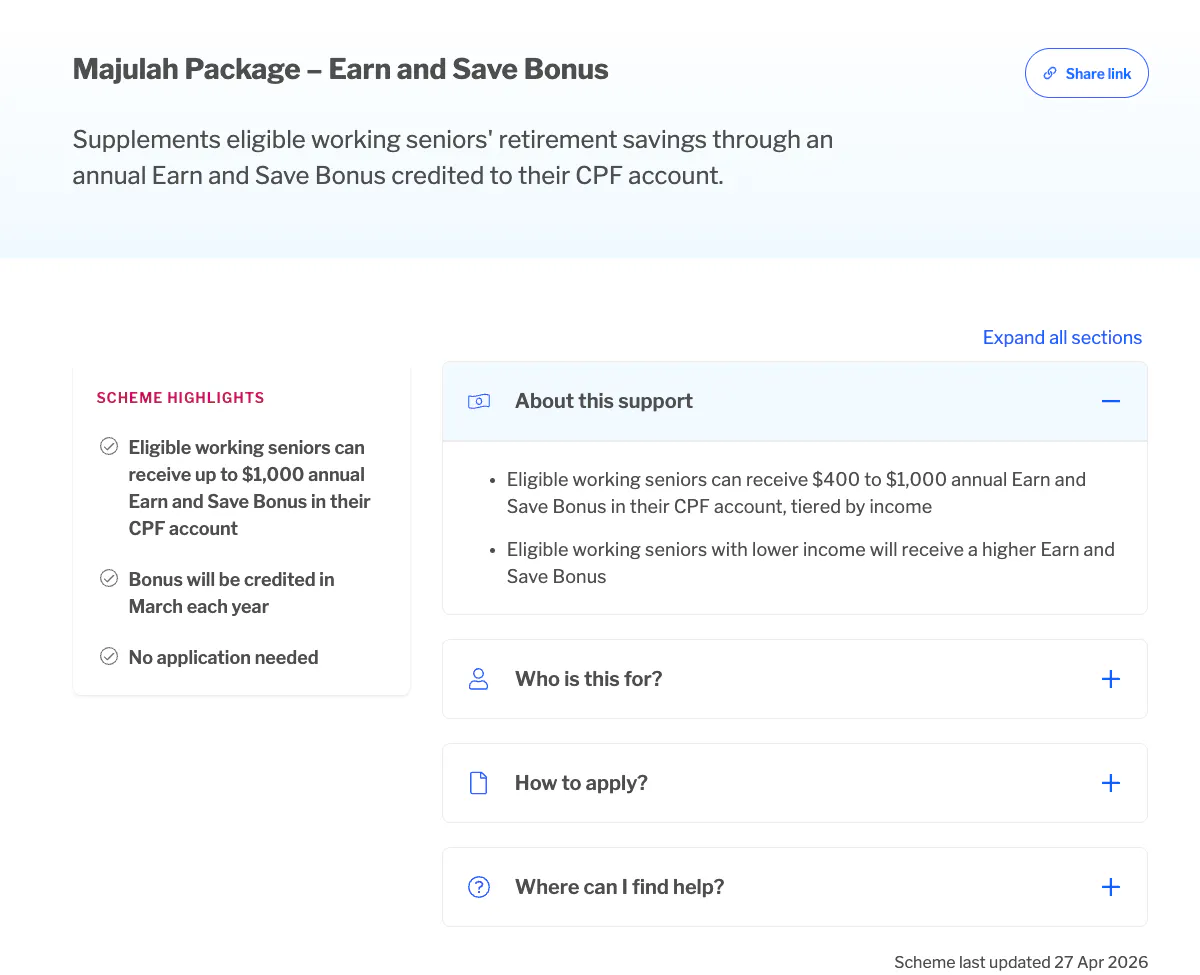
- Majulah Package Earn and Save Bonus - up to $1,000/year CPF top-up for SCs born 1960-1973. Lands in MA or RA depending on age. Stacks with your own cash top-ups. See our Majulah Package guide
- GST Voucher MediSave - automatic CPF MediSave top-up for SCs aged 65+ with assessable income $34,000 or less. Counts toward the BHS cap, so plan your MediSave cash top-ups around it. See our GST Voucher 2026 guide
For the full schedule of all 2026 government cash and CPF disbursements, see our Singapore Government Payouts 2026 hub
9. Common mistakes and the 31 December deadline
Topping up after 31 December - the relief is gone
Tax relief is claimed in the year of assessment based on when CPF Board RECEIVES the cash, not when you initiate the transfer. A bank GIRO instruction sent on 30 December that lands on 2 January counts for the next year, not the year you wanted.
Use PayNow QR via the CPF app for any top-up after 28 December. Same-day credit, no GIRO lag.
Hitting the Basic Healthcare Sum mid-year
If your MediSave hits the BHS through regular employment contributions, GST Voucher MediSave or Majulah Bonus, your remaining cash top-up window for the year shrinks. CPF Board automatically rejects the excess and refunds it - but the rejected amount does not generate tax relief.
Topping up your RA above the ERS - the excess is also rejected
For members 55+, RA is capped at the current year's Enhanced Retirement Sum (ERS) of $440,800 in 2026. Cash top-ups exceeding the ERS are refunded in full. Plan your top-up amount based on your CURRENT RA balance, not last year's.
Topping up a spouse who earns more than $4,000
The $4,000 income test for spouse and sibling top-ups is strict. Tax relief is denied even by $1 over the threshold. If you are uncertain about your spouse's annual income for the year, top up to a parent or parent-in-law instead - no income test there.
Forgetting that CPF transfers don't count
A CPF transfer (moving funds from your own OA to your own SA, for example) is not a cash top-up. It does not generate tax relief, even though the money sits in the same account a cash top-up would have. Only fresh cash going INTO CPF qualifies.
10. Action checklist for getting maximum tax relief in 2026
A short five-step checklist to make sure you capture the full $16,000 of CPF cash top-up tax relief in 2026.
- Check your remaining top-up capacity - log in to the CPF app, go to Retirement Dashboard, and look for "Top-up Limits". This shows the maximum you can still top up to your SA, RA or MediSave this year
- Top up MRSS first if your parent qualifies - the 1-for-1 Government match beats the regular tax relief. $2,000 max per parent per year, lifetime $20,000
- Top up your own SA or RA up to $8,000 - default to RA top-up if you're 55+, SA if under 55. Both reduce your taxable income by the same amount
- Top up loved ones up to $8,000 - prioritise parents and parents-in-law (no income test). Add spouse and siblings only if their income is $4,000 or less
- Settle all top-ups by 28 December via PayNow QR - bank GIRO lag can push payments into January, killing the relief for that calendar year
Last verified: 6 May 2026. Sources: CPF Board (cpf.gov.sg), IRAS.