

UOB One vs OCBC 360 Singapore 2026: Which Account Pays More?


UOB One vs OCBC 360: the short answer
Both accounts pay among the highest bonus interest rates in Singapore, but the answer depends on your balance tier and which credit card you can pair.
UOB One wins for balances under S$50,000 and for users who already hold the UOB One Card.
OCBC 360 wins above S$50,000 if you can hit the full salary plus spend plus save plus invest stack.
May 2026 top tiers: UOB One pays 3.30 per cent on the top S$25,000 slice with the full Lite stack. OCBC 360 pays 4.65 per cent on the full S$100,000 balance with the full stack including the invest booster. Skip the invest booster on OCBC and the realistic blended rate drops to 3.50 per cent, putting UOB One back in front for most mid-tier balances.
Both rates verified against the bank websites on 11 May 2026. If you have not picked your savings account yet, start with the Best Savings Account Singapore 2026 guide for the full tier-by-tier comparison.
Table of Contents
1. Quick verdict by balance tier
2. Top-tier rates side-by-side
4. The spend-trigger card: UOB One Card vs OCBC 365
5. Worked example: S$25,000 balance
6. Worked example: S$75,000 balance
7. Worked example: S$150,000 balance (split-account play)
9. What to know before switching
1. Quick verdict by balance tier
Your situation | Winner | Why |
Balance under S$25,000, no salary credit | UOB One | Easier qualification: card spend OR three GIRO |
Balance S$25,000 to S$50,000, salary credited | UOB One | Top tier 3.30 per cent on full balance |
Balance S$50,000 to S$100,000, full stack possible | OCBC 360 | Bonus pool extends to S$100,000 (UOB caps at S$75k) |
Balance above S$100,000 | Split: OCBC 360 + UOB One | Fill both bonus caps; park excess in T-bills |
Already hold UOB One Card | UOB One | Card spend trigger costs nothing; you already earn 5% cashback |
Already hold OCBC 365 | OCBC 360 | Same logic in reverse |
No credit card spend, no salary credit | Neither: pick Trust or MariBank | Both UOB and OCBC require at least one bonus lever |
2. Top-tier rates side-by-side
The headline numbers most aggregators show. Important: these are theoretical maximums, not realistic blended rates. We compute the blended rate for each scenario in sections 5, 6 and 7.
Lever | UOB One (bonus added) | OCBC 360 (bonus added) |
Base rate | 0.05 per cent on full balance | 0.05 per cent on full balance |
Salary credit (S$1,600 UOB / S$1,800 OCBC) | +1.10 per cent (Tier 1) | +1.20 per cent on S$25k slabs |
Card spend (S$500 minimum) | +0.85 per cent (Tier 1) | +0.60 per cent on S$25k slabs |
Three GIRO bills | +0.20 per cent (boost tier) | Not a separate lever |
Save S$500 more this month than last | Not a separate lever | +1.20 per cent on S$25k slabs |
Invest in qualifying product (S$20k OCBC / S$10k UOB) | +0.45 per cent (Wealth tier) | +1.20 per cent on S$25k slabs |
Insure with qualifying policy | Not a separate lever | +1.20 per cent on S$25k slabs |
Bonus cap | S$75,000 (S$150k for premier) | S$100,000 |
Top tier headline rate | 3.30 per cent | 4.65 per cent |
Two key structural differences. First, UOB One pays the top tier on the TOP S$25,000 slab (S$50,001 to S$75,000), not on the full balance. OCBC 360 pays a different bonus on each S$25,000 slab. Second, OCBC's invest and insure boosters add 1.20 per cent each but require S$20,000 in a qualifying product. Skip them and you land at 2.25 per cent blended.
'%20fill='url(%23a)'%20fill-rule='evenodd'%20opacity='.04'/%3e%3c/svg%3e)
3. The 4 levers compared
Lever 1: Salary credit
UOB One requires S$1,600 minimum salary via GIRO. OCBC 360 requires S$1,800. Both check the GIRO ASCII code (SALA). If you split salary across two banks, only one qualifies. We cover the split workaround in section 8.
Lever 2: Card spend
UOB One requires S$500 a month on any UOB credit card OR S$500 on the UOB One Debit Card. OCBC 360 requires S$500 on any OCBC credit card. Pairing the right card is critical because the card's own cashback rate compounds on the same S$500.
Lever 3: Save vs GIRO
UOB One offers GIRO bills as a substitute for card spend (3 bills, lower bonus). OCBC 360 instead awards a 'save more this month than last month' tier (S$500 net new savings). The OCBC save tier is harder to maintain long-term because every month requires fresh savings.
Lever 4: Invest or insure
UOB One has a single Wealth tier (S$10,000 in qualifying unit trust or insurance). OCBC 360 has two separate boosters (invest tier and insure tier, S$20,000 each). OCBC pays more for the lever but demands more capital tied up.
4. The spend-trigger card: UOB One Card vs OCBC 365
This is where the two ecosystems separate. The card you spend on for the bonus trigger also earns its own cashback or rewards. Pick the wrong card and you forfeit either the account bonus or the card earn rate.
Pair with UOB One: the UOB One Card
UOB One Card pays up to 10 per cent on Shopee, Foodpanda, SimplyGo and SP Group when you spend S$2,000 a quarter.
At S$500 a month (S$1,500 a quarter) you fall short of the 10 per cent tier and earn 3.33 per cent base.
Push to S$2,000+ and the bonus kicks in. For most users, the 3.33 per cent base on S$500 is S$200 a year of card cashback ON TOP of the account bonus.
| Card | Bonus/Rewards | Terms |
UOB One 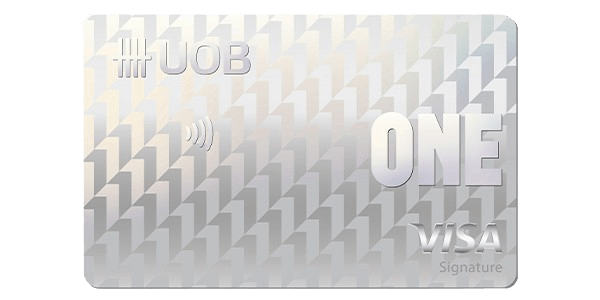 Apply by 30 Sept 2026 | First NTC at 2pm & 10pm:
Remaining NTCs:
| Apply for any participating UOB Credit Card, be an approved new-to-card (NTC) customer, and spend at least S$500 within the first month. Terms and Conditions apply. |
Pair with OCBC 360: the OCBC 365 Card
OCBC 365 pays 6 per cent on dining, groceries, transport, petrol and online groceries (capped at S$80 cashback monthly, S$800 minimum spend). At S$500 monthly spend you stay below the S$800 minimum, so you earn the base 0.30 per cent. Push to S$800+ and the 6 per cent kicks in (S$48 a month at full cap). For dining-heavy users this is roughly S$500 a year of card cashback ON TOP of the account bonus.
| Card | Bonus/Rewards | Terms |
OCBC 365 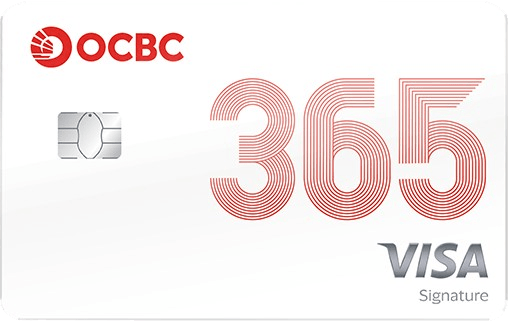 Apply by 30 Sept 2026 | Choose from:
| Valid for new OCBC CC holders only. Spend a min. of $400 in qualifying transactions within 30 days of card approval. |
5. Worked example: S$25,000 balance
Realistic scenario: salary S$5,000 monthly, S$500 card spend, no investment booster, no insurance booster. We compute monthly and annual interest assuming the balance sits steady at S$25,000 for a full year.
Account | Effective rate | Annual interest |
UOB One (salary + S$500 UOB One Card) | 2.30 per cent (blended) | S$575 |
OCBC 360 (salary + S$500 OCBC 365 + save more) | 3.00 per cent (blended) | S$750 |
UOB One (above) + UOB One Card cashback | Plus S$200 card rebate | S$775 total return |
OCBC 360 (above) + OCBC 365 cashback | Plus S$500 card rebate (if S$800/mo spend) | S$1,250 total return |
Verdict at S$25,000: OCBC 360 wins on account interest. But the gap is only S$175 a year on bonus interest. The bigger story is the card pairing: OCBC 365 at S$800 monthly spend earns S$500 cashback, dominating UOB One Card's S$200 base. If you cannot push to S$800 OCBC spend, UOB One wins on simplicity.
6. Worked example: S$75,000 balance
Realistic scenario: balance S$75,000, salary credited, S$500 card spend, no investment booster. This is the maximum tier where UOB One pays full bonus (cap S$75k).
Account | Effective rate | Annual interest |
UOB One (salary + S$500 card) | 2.40 per cent (blended, hits S$75k cap) | S$1,800 |
OCBC 360 (salary + S$500 card + save more) | 3.45 per cent (blended) | S$2,587 |
OCBC 360 (full stack including invest S$20k) | 4.10 per cent (blended) | S$3,075 |
Verdict at S$75,000: OCBC 360 wins by S$787 a year on the standard stack, and by S$1,275 a year with the invest booster activated. UOB One's S$75k cap starts to bite at this tier. If you can park S$20,000 in a qualifying OCBC unit trust or insurance policy you would have bought anyway, OCBC 360 dominates.
7. Worked example: S$150,000 balance (split-account play)
Realistic scenario: balance S$150,000. Both single accounts cap below this. The split-account play fills both bonus pools and parks the excess in T-bills.
Strategy | Effective blended rate | Annual interest (full balance) |
Single UOB One (S$75k bonus + S$75k base) | 1.50 per cent (averaged) | S$2,250 |
Single OCBC 360 (S$100k bonus + S$50k base) | 2.85 per cent (averaged) | S$4,275 |
Split: S$100k OCBC 360 + S$50k UOB One | 3.50 per cent (averaged) | S$5,250 |
Split + S$50k OCBC 360 + S$75k UOB One + S$25k T-bill | 3.60 per cent (averaged) | S$5,400 |
The split-account play earns S$1,000+ a year more than parking everything in either bank alone. The cost is one extra GIRO bill setup and a small admin overhead.
For the cash above the combined S$175,000 bonus cap, T-bills are the cleanest top-slice. See the FD vs T-bills vs SSB guide for the year-by-year math.


8. The salary-credit conflict
Only one bank receives your monthly salary GIRO. If you hold BOTH UOB One and OCBC 360, you cannot claim the salary credit lever on both. Pick the bank with the larger balance and route salary there.
The workaround: GIRO bills
For the second account, replace the salary lever with the 'three GIRO bills' lever on UOB One (loses about half the salary bonus) or the 'save more this month' lever on OCBC 360. Both are easier to maintain than chasing a salary split.
The harder workaround: dual-employer salary split
If you control your salary GIRO (self-employed, freelance, multiple jobs), you can split S$1,800 to OCBC and S$1,600 to UOB. Both banks treat each GIRO as independent and award the bonus to each. Most employees cannot do this.
9. What to know before switching
Gotcha 1: Rate cuts in 2024 and 2025
UOB One cut from 4.00 per cent to 3.30 per cent between October 2024 and April 2025. OCBC 360 held at 4.65 per cent but reduced the salary slab from S$25k to a tiered 25-25-25-25k structure. Always check the bank's terms-and-conditions page for the latest tier table.
Gotcha 2: Save tier resets every month (OCBC)
OCBC's 'save S$500 more this month than last month' booster compares this month's average daily balance against last month's. Hit it for 3 months in a row and the lever requires a permanent net inflow of S$1,500. The lever quietly becomes harder over time.
Gotcha 3: UOB One cap is S$75k, not S$100k
Many people assume the bonus cap is S$100k. UOB One caps at S$75k for the standard account. UOB Privilege Banking customers get a S$150k cap. Above S$75k, the marginal interest drops to 0.05 per cent base.
Gotcha 4: Card-spend cycles do not align with statement cycles
Both UOB One and OCBC 360 measure card spend against the bonus eligibility window (calendar month for UOB; statement month for OCBC). If your card statement cuts on the 15th, OCBC measures Jan 15 to Feb 14. Misalign and you may miss the spend bonus while still hitting the card's own minimum.
Gotcha 5: First-month delay
Both banks measure the first bonus month from the month AFTER you open the account. Open in May, first bonus tier counts in June statement. Plan around this if you switch banks.
10. When to switch (and the timing pitfall)
Switching savings accounts is cheap (no exit fee) but the timing trap is real. Both banks calculate bonus interest on the LOWEST daily balance of the month. Move S$50,000 from UOB to OCBC mid-month and your UOB balance is briefly zero, killing UOB's bonus for that month.
The clean switch sequence
- Day 1 to 28: keep both accounts running with the existing salary GIRO going to UOB
- Day 29 of month: open OCBC 360 if not already open. Fund with S$1,000 cash to activate.
- Day 1 of next month: update salary GIRO to OCBC. Move bulk transfer S$X from UOB to OCBC.
- Day 1 of following month: UOB receives final salary, then close (or downgrade to a no-fee account)
This protects both banks' bonus interest for the transition month. For balances above S$100,000, do not close UOB at all. Keep both running for the split-account play in section 7.
11. FAQ
Q1: Which is better overall, UOB One or OCBC 360?
Neither is universally better. Under S$50,000 balance with simple stack: UOB One. Above S$50,000 with full stack: OCBC 360. Above S$100,000: run both.
Q2: Can I open both accounts?
Yes. The only restriction is the salary credit lever. only one bank receives the salary GIRO. The other account uses an alternative bonus lever (GIRO bills or save-more tier).
Q3: Do I need to use the UOB One Card or OCBC 365 Card?
Not strictly. any UOB credit or debit card qualifies for UOB One's spend tier; any OCBC credit card qualifies for OCBC 360's. But UOB One Card and OCBC 365 pay the highest cashback on the same S$500 you would spend anyway, so they are the obvious pairings.
Q4: What if I cannot hit the card spend?
UOB One: switch to the three GIRO bills lever (loses about half the salary bonus). OCBC 360: try the 'save more this month' lever (requires S$500 of net new savings each month). If neither works for you, switch to a no-conditions account like MariBank or Trust.
Q5: What about DBS Multiplier and SCB Bonus$aver?
DBS Multiplier was cut hard in 2025 and now pays 1.50 to 2.20 per cent realistically. below both UOB and OCBC. SCB Bonus$aver pays up to 6.70 per cent but requires invest AND insure boosters (S$30k each). For the head-to-head bracket of UOB One vs OCBC 360, see the savings pillar for SCB's place in the broader matrix.
12. Bottom line
UOB One is the easier path for balances under S$50,000 and for users who already pair UOB. OCBC 360 is the higher ceiling for balances S$50,000 to S$100,000 with full stack. Above S$100,000 the answer is both, with cash above the combined cap parked in T-bills.
And the card you pair with the account matters as much as the account itself. UOB One Card with UOB One. OCBC 365 with OCBC 360. The card cashback alone often exceeds the bonus interest difference between the two accounts.
Related guides
If you have not picked your savings account yet, the Best Savings Account Singapore 2026 guide walks through every account by balance tier, including the MariBank and Trust no-conditions picks.
For the broader credit-card-spend trigger decision (cashback vs miles vs no annual fee), see the Best Credit Cards Singapore 2026 decision guide.
If you have cash above the combined bonus caps, the FD vs T-bills vs Singapore Savings Bond guide compares the three with year-by-year math.